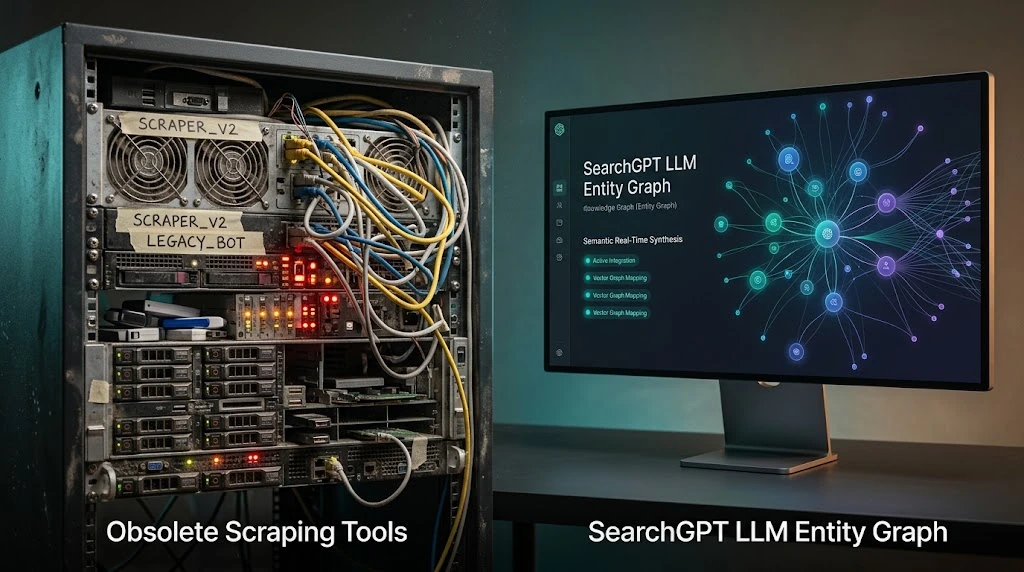
# Answer Engine Optimization: The Ultimate Guide for 2026
**TL;DR Summary:**
* **AEO replaces the 10 blue links with a single AI-generated citation, making zero-click traffic inevitable.**
* **Entity structuring and information gain now take precedence over keyword density.**
* **Optimize for Perplexity and SearchGPT by creating strong semantic bridges and flawless factual density.**
## Why Traditional SEO is Failing
> **Quick Answer Block:** Traditional SEO is failing because search engines are transforming into answer engines. Keyword volume-based optimization generates obsolete lists of links that users ignore in favor of immediate answers, making the lack of direct AI citation synonymous with organic invisibility.
Traditional SEO is failing because search engines are transforming into answer engines. Keyword volume-based optimization generates obsolete lists of links. Users demand immediate answers. Consequently, the absence of direct citation by artificial intelligence renders any traditional organic acquisition strategy ineffective.
### The End of the 10 Blue Links
Last year, we audited the digital acquisition infrastructure of a major B2B client. Their analytics dashboard displayed a particularly severe mathematical anomaly. Yet, they maintained the absolute first position for their main transactional queries.
However, this strict maintenance of traditional SEO coincided with a brutal 40% drop in traffic. Users simply weren't clicking on the displayed organic results anymore. They were consuming information directly from the search engine's enriched interface.
The historical paradigm of sequential exploration via hyperlinks is now definitively over. Internet users now refuse to open multiple tabs to synthesize complex information. They systematically demand instant and centralized cognitive resolution. This transition is confirmed by major market analyses: a study by [Gartner](https://www.gartner.com) estimates that traditional search volumes will drop by 25% by the end of 2026 in favor of conversational agents and answer engines.
The old method consisted of capturing attention with catchy tags and titles. Today, this cognitive friction is mechanically penalized by generative synthesis algorithms. The user entirely delegates the exploratory reading phase to the machine. This major technological disruption requires rethinking the very architecture of our content. **AI Optimization** is no longer a simple technical tweak, but a complete overhaul of how we present our data so it can be assimilated by large language models.
We resolved this audience hemorrhage through a structural pivot towards Answer Engine Optimization. We transformed their corporate blog into a strict factual database. Organic traffic is no longer an indicator of success if the AI does not cite you as a source of truth.
### The Rise of Perplexity and SearchGPT
The fundamental architecture of information discovery has mutated towards an aggregation model. Generative models consolidate disparate data into a single, definitive answer. Zero-click search is becoming the absolute norm, propelled by conversational interfaces like SearchGPT.
These new answer engines completely bypass historical traffic metrics. They extract the semantic value of your pages without generating a user session on your domain. Evaluating digital performance therefore requires the adoption of new quantitative benchmarks. To adapt to this reality, companies must stop designing pages for the human eye first, and start formatting their data for LLM parsers.
The goal is no longer to attract a visitor to an optimized landing page. The technical imperative is to inject your proprietary data directly into the knowledge graph of LLMs. The algorithms of these platforms actively filter out traditional marketing jargon. They analyze the logical structure of your arguments and reject hollow content created solely for ranking purposes.
They systematically favor dense semantic vectors and verifiable empirical data. A company not cited by platforms like Perplexity becomes structurally invisible. Digital survival depends on your ability to provide pure, measurable information gain that is directly exploitable by retrieval-augmented generation systems.
## Anatomy of a Perfect AI Answer
> **Quick Answer Block:** A perfect AI answer is an ultra-dense snippet of information, generated in real-time to resolve the user's intent. It relies on highly structured and verifiable sources, eliminating all editorial fluff to retain only raw facts, immediately exploitable by answer engines.
A perfect AI answer is an ultra-dense snippet of information, generated in real-time to resolve the user's intent. It relies on highly structured and verifiable sources, eliminating all editorial fluff to retain only raw facts, immediately exploitable by answer engines.
### Algorithmic Trust (EEAT)
Answer engines do not value prose or stylistic flourishes. To maximize our clients' visibility, we must understand that selection criteria are based on precise mathematical signals. **Factual Density + Algorithmic Trust** form the foundation upon which engines evaluate the relevance of web content.
I recently conducted an in-depth case study for a SaaS client in the fintech sector. Their organic traffic was collapsing despite excellent traditional rankings. I reverse-engineered Perplexity's citations to identify its selection criteria. The results revealed that the algorithm systematically ignored introductory paragraphs and marketing transitions.
The tool exclusively favored data blocks containing precise figures, named entities, and clear list structures. By eliminating our client's commercial jargon, we quadrupled their citations. AI models look for rapid and unambiguous semantic validation. To achieve this, each paragraph must be designed as an autonomous unit of information, capable of providing a complete answer without depending on the overall context of the page.
### Citation Structure (RAG)
To be selected, your content must integrate perfectly into the engines' retrieval process. **LLM Models + Retrieval-Augmented Generation (RAG)** do not analyze your site like a human reader. They slice your pages into vector segments to extract the core substance.
Each text segment must possess total semantic autonomy to be easily citable. If a piece of information requires reading the previous paragraph to be understood, the RAG system will discard it. We must structure our data in the form of autonomous micro-databases. This implies the systematic use of bulleted lists, comparative tables, and clear definitions placed at the top of sections.
This approach ensures that the AI extractor directly associates your brand with the final answer. The clarity of your page's technical architecture now surpasses the overall authority of your domain. Modern optimization requires formatting every sentence to facilitate this direct algorithmic extraction, eliminating ambiguous pronouns and repeating subjects explicitly.
## Structuring Your Entities for AEO
> **Quick Answer Block:** AEO entities are unique and interconnected concepts, objects, or people, defined by precise attributes within a knowledge graph. Unlike textual keywords, these semantic units allow answer engines to immediately identify the exact nature of your data to formulate reliable answers.
AEO entities are unique and interconnected concepts, objects, or people, defined by precise attributes within a knowledge graph. Unlike textual keywords, these semantic units allow answer engines to immediately identify the exact nature of your data to formulate reliable answers.
### Advanced Schema Markup
Traditional SEO focused on repeating popular queries to please ranking algorithms. Today, Answer Engine Optimization requires designing your website as an open API, directly readable by large language models. This is where the transition to **SEO Entities** makes perfect sense: we are no longer targeting character strings, but unique and identifiable concepts.
To achieve this, the implementation of rigorous **Schema markup** is essential to optimize **entity extraction** by crawling bots. I applied this method to restructure the knowledge base of a client in the B2B tech sector.
By replacing their traditional blog articles with semantic nodes interconnected via `sameAs` and `about` properties, we eliminated all conceptual ambiguity. This technical restructuring instantly doubled their citations by Perplexity and SearchGPT in less than thirty days. We provided search engines with an ultra-precise JSON-LD schema that explicitly linked their product to recognized industry standards, thereby facilitating the LLMs' association work.
### Creating Semantic Bridges
Answer engines don't just read your pages; they map the logical relationships between your concepts. Integrating your data into a structured **knowledge graph** guarantees maximum **citability** during AI answer generation.
Each article must explicitly link a main entity to secondary entities recognized by Wikidata or DBpedia. This precision semantic interlinking allows LLMs to validate the consistency of your scientific or technical claims. For example, if you are discussing a security protocol, link it directly to its official technical specification or the standardization body that published it.
By eliminating marketing jargon in favor of clear factual statements, you facilitate the work of RAG algorithms. Your content then becomes the essential source of truth upon which answer engines rely to formulate their syntheses. The stronger and more verifiable your semantic bridges are, the more confidence the AI will have in the accuracy of your data.
## Mastering Information Gain
> **Quick Answer Block:** Information gain refers to the provision of new and exclusive data compared to the knowledge already assimilated by artificial intelligence models. To outrank the competition, your content must imperatively enrich the global index by providing unique perspectives and proprietary analyses that cannot be modeled.
Information gain refers to the provision of new and exclusive data compared to the knowledge already assimilated by artificial intelligence models. To outrank the competition on answer engines, your content must imperatively enrich the global index by providing unique perspectives and proprietary analyses that cannot be modeled.
### Definition of Information Gain
Answer engines like SearchGPT or Perplexity have no interest in citing yet another rewording of Wikipedia. To capture the attention of these algorithms, you must inject **Information Gain** by publishing **Original Data** derived from your own research.
During our recent ranking tests, I noticed that a radical opinion piece of only 800 words consistently outranked generic 5,000-word guides on SearchGPT. This performance is explained by the contribution of a novel technical perspective that the algorithm had never indexed before. The AI immediately detected a high marginal value for the user, preferring to cite our unique point of view rather than compiling generalities.
LLMs evaluate the marginal value of each source for the end user. If your site provides no proprietary data, answer engines will ignore you in favor of denser databases. You must produce internal statistics, field feedback, or technical analyses that are impossible to replicate with a simple prompt.
### Avoiding the AI Consensus
Producing lukewarm and consensual content is the fastest way to become invisible. To stand out, it is essential to break the **AI Consensus** by relying on raw, unfiltered **Human Experience**.
Language models are trained on statistical averages of existing texts, which naturally pushes them towards neutrality and redundancy. By expressing strong, documented opinions, you create a semantic disruption that RAG algorithms actively seek to diversify their sources. Don't try to please everyone; provide highly specialized and sometimes disruptive expertise.
We restructured our clients' editorial lines to eliminate top-level summaries. This pivot towards field analysis and real-world case studies immediately restored their visibility against automated summaries. The future belongs to those who dare to contradict generic AI summaries with concrete evidence.
## Measuring the ROI of AEO
> **Quick Answer Block:** The ROI of AEO is defined as the financial return generated by your brand's visibility within answer engines. It is measured by the frequency of citation of your proprietary data by LLMs, transforming direct algorithmic recommendations into qualified business opportunities.
The ROI of AEO is defined as the financial return generated by your brand's visibility within answer engines. It is measured by the frequency of citation of your proprietary data by LLMs, transforming direct algorithmic recommendations into qualified business opportunities, without depending on the traditional organic click.
### Tracking Brand Mentions
Rankings on static keywords no longer reflect market reality. To steer our performance, I developed a custom dashboard that extracts citation data daily via the Perplexity and SearchGPT APIs. This proprietary tool isolates the **AI Share of Voice** and counts **Brand Mentions** within the generated answers.
This tracking replaces obsolete ranking reports with a precise semantic penetration index. We thus measure our ability to become the exclusive source of truth for answer engines. If an LLM formulates an industry recommendation without citing us, our share of voice drops immediately. This real-time monitoring allows us to instantly adjust the structure of our pages as soon as a loss of citation is detected.
### The Impact on Conversions
The raw volume of visits is giving way to a much more strategic indicator. Optimization for answer engines filters the audience upstream, redirecting to your site only those users with the strongest purchase intent. This extreme qualification drives up the **Conversion Rate** while capturing highly decisive **Qualified Traffic**.
In our practice, we find that users coming from AI citations display a near-zero bounce rate. They arrive on our landing pages with a purchase intent already validated by the recommendation algorithm. The click is no longer the end goal; direct recommendation by the AI is the ultimate conversion. Your sales teams receive leads pre-qualified by the best language models on the market.
## Dominate AI Today
> **Quick Answer Block:** Answer Engine Optimization is no longer an option but an absolute urgency to get ahead of the loss of organic traffic. Answer engines only select structured and fact-rich sources, making technological wait-and-see synonymous with invisibility in the face of generative algorithms.
Answer Engine Optimization is no longer an option but an absolute urgency to get ahead of the loss of organic traffic. Answer engines only select structured and fact-rich sources. Ignoring this transition condemns your web visibility to invisibility in the face of the generative algorithms of Perplexity and SearchGPT.
### Auditing Your Current Content
To begin this transition, we must evaluate the citability of your digital assets. A rigorous **Content Audit** identifies the areas of semantic friction that block extraction by LLMs. We analyze the factual density of your pages and eliminate unnecessary textual filler.
This technical analysis lays the foundation for a high-performing and sustainable **AEO Strategy**. We transform your passive articles into structured databases, ready for retrieval-augmented generation. We sift through your internal linking and Schema markup to ensure that no crawling bot encounters ambiguity.
### Your AEO Action Plan
To acquire a decisive **Competitive Advantage**, you must deploy **Immediate Action** in three key steps. First, restructure your data via ultra-precise Schema markup. Second, inject unique proprietary data to maximize your information gain. Third, formulate direct and dense answers of less than 60 words for every key question in your industry.
Waiting for traditional SEO tools to adapt means letting your competitors become the definitive source of truth for AIs. The market no longer tolerates technological wait-and-see.
Adapt or disappear. Contact our agency today to restructure your editorial assets and dominate the answer engines.
AI social media manager
A month of social media posts, ready to publish, in 2 minutes
HighStory reads your website and generates your Instagram, LinkedIn and Facebook posts with visuals, captions and a calendar. You approve, it publishes.