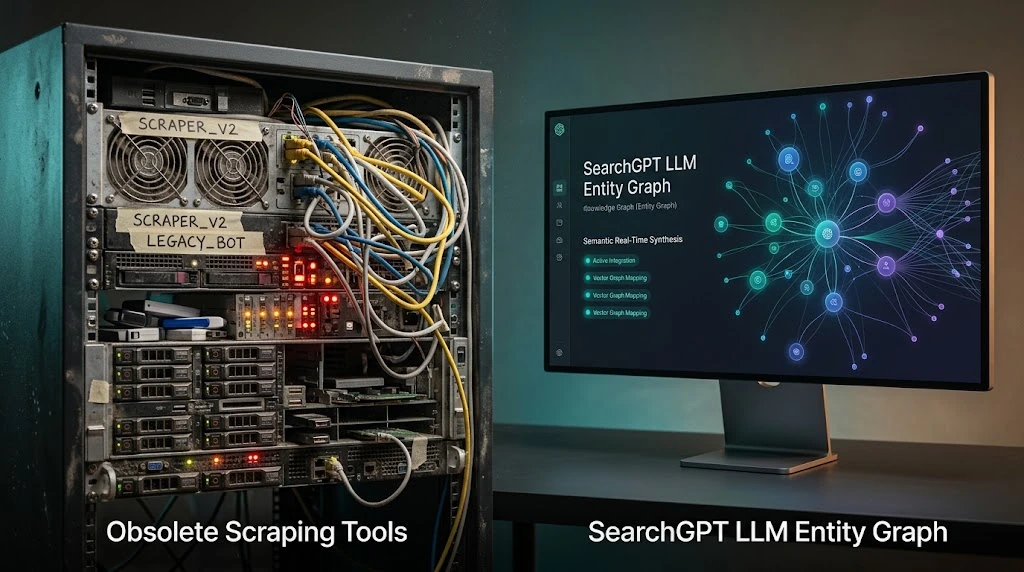
# Why the 9-Episode Content Funnel is Dead (And How We Replaced It with an Infinite Engine)
I used to swear by the 9-episode funnel.
Three pieces of Top-of-Funnel (TOFU) content to grab attention. Three Middle-of-Funnel (MOFU) pieces to build trust. Three Bottom-of-Funnel (BOFU) pieces to close the deal. It looked beautiful on a whiteboard. It was logical. It was structured.
And in 2026, it is completely useless.
We learned this the hard way. We spent $14,500 producing a meticulously planned 9-part series. Episode 1 got 4,000 views. By the time "Episode 3: The Action Plan" hit the feeds, it got 12. We lost 99% of our audience in three days for a strategy that was fundamentally broken.
### The Algorithm Shift: Chronological Distribution is Gone
The reason the 9-episode funnel died is simple. Algorithms on TikTok, Reels, and LinkedIn do not care about your timeline.
They do not distribute content chronologically anymore.
If a user is scrolling their For You page and suddenly sees *"Episode 3: The Action Plan,"* they have zero context. They didn't see Episode 1. They don't know who we are. They don't know what the plan is for.
What happens next? They swipe away in two seconds.
That instant skip sends a massive negative signal to the algorithm. The retention rate tanks. The post is dead before it even had a chance, taking the entire linear series down with it.
That catastrophic drop forced us to ask a question we had actively ignored: if chronological discovery is dead, how do we structure content for modern platforms?
### What is Answer Engine Optimization (AEO)?
Answer Engine Optimization (AEO) is the practice of structuring digital content to be directly extracted and cited as factual answers by AI search engines like Perplexity, SearchGPT, and social platforms operating as primary search interfaces.
We realized that to survive, we couldn't rely on users following a breadcrumb trail. Every single piece of content had to stand alone and answer a specific question directly. The platforms themselves are changing. They aren't just feeds anymore; they are search engines.
This shift meant we needed a new architecture, leading us directly to a concept that would save our entire operation.
### What are Modular Content Franchises?
Modular Content Franchises are recurring, standalone content formats designed around a specific theme or structure that allow users to enter the content universe at any point without friction or missing context.
This was the breakthrough.
Instead of a rigid series that dies at episode 9, we shifted to franchises. Think of it like a TV show where every episode is a self-contained story, but the characters remain the same.
We created formats like *"The Tuesday Teardown"* or *"The $10,000 Mistake."*
> A user can discover "The Anti-Advice #12" without needing to see episodes 1 through 11.
Every post is 100% autonomous. The algorithm can serve any piece of content to any user at any time, and it still makes perfect sense. There is no friction. There is no lost context. Just immediate, standalone value that builds familiarity over time.
---
## The False God of 'AI-Generated Content': Why Founders Must Be the Source Code
### The Zero-AI Founder Rule
I see it every day. Founders spinning up ChatGPT, asking for a "thought leadership post," and pasting the resulting slop directly to LinkedIn. It's a disaster.
AI is not a creator. It's an accelerator.
The core ideas—the actual substance—must come from a human being. The raw, unpolished insights. The rants you go on during internal meetings. The hard-won lessons from the field. That is the source code.
If the AI generates the idea, you are already dead in the water. The algorithm will smell the generic output, and your audience will scroll past the "architecture" of your "multifaceted landscape" in two seconds flat.
We learned this the hard way.
We built a system at HighStory to completely automate content creation. And it failed. Miserably. Why? Because the input was garbage. We were asking the AI to invent the thought leadership.
So, we flipped the model. We implemented the Zero-AI Founder Rule.
Now, the AI generates absolutely nothing in Category 1. The founder simply publishes their raw facecam videos, their unfiltered takes, their genuine experiences.
Then, our methodology goes to work. It doesn't write. It listens.
It scrapes the real-world metrics from that raw post. It looks at saves, shares, and dwell time. Most importantly, it isolates two critical pieces of data:
1. **The Winning Hook:** The exact phrase or first two lines that made the reach explode.
2. **The Comment Objections:** The specific questions, frustrations, and pushback from prospects in the comment section.
That data—the hook and the objections—is the gold. It gets logged into the workspace memory. *That* is what automatically feeds the topics for the rest of the content engine.
This realization fundamentally changes the business model of content creation, forcing us to answer a difficult question about our own industry.
### Will AI replace content agencies billable hours?
Yes, AI will entirely replace traditional billable hours for low-level content creation, forcing agencies to pivot toward Content-as-a-Service (CaaS) models focused strictly on strategy, data capture, and managing automated generation engines.
The days of paying an agency $150 an hour to write a generic blog post are over, not just because AI is cheaper, but because manual labor cannot keep pace with the volume required for Dark Social testing.
The value is no longer in the keystrokes. The value is in the system. The value is in capturing the founder's raw signal and building the engine to distribute it effectively.
Agencies that survive won't sell words. They will sell the architecture of the Infinite Content Engine.
---
## The Paradigm Shift: Social Platforms are the New Search Engines
### Social SEO and the 4 Search Intents
By 2026, TikTok, Instagram, and LinkedIn are no longer just social networks. They are search engines.
Since Google's integration of TikTok and Reddit results in 2024, it now indexes social posts directly. AI engines like Perplexity and SearchGPT cite LinkedIn posts and Instagram carousels as primary sources. The line between 'social media' and 'search' is completely gone.
To dominate this new reality, we don't just post. We map.
We pull raw data from Google's People Also Ask (PAA), TikTok search suggestions, and niche Reddit threads. Then, we map those specific queries directly to the four core search intents:
* **Informational:** "How to configure X without paying Y?" (The hook is the exact question; the first sentence is a direct 45-word answer).
* **Commercial:** "The 3 only tools needed to automate X in 2026."
* **Comparison:** "[Method A] vs [Method B]: Which converts higher?"
* **Transactional:** "The exact template to apply X tonight (Link / DM)."
> This isn't guessing. This is engineering visibility.
But here's the trap: repeating yourself.
To prevent the engine from running in circles, we built a strict anti-repetition mechanism. Every question we tackle is logged in the `content_calendar` alongside its `target_seo_keyword`. When the next batch runs, the system is forced to move to the next semantic cluster in the search graph. With hundreds of long-tail queries per sector, the engine never repeats a topic. It just expands the footprint.
This mapping process requires a completely different approach to measurement than we used five years ago.
### Traditional SEO vs. AEO vs. Social SEO
Understanding the difference in how these platforms track and attribute success is the only way to measure ROI accurately.
| Feature | Traditional SEO | Answer Engine Optimization (AEO) | Social SEO |
| :--- | :--- | :--- | :--- |
| **Primary Goal** | Rank on Google Page 1. | Be cited by AI (Perplexity, SearchGPT). | Rank in in-app search (TikTok, LinkedIn). |
| **Content Format** | Long-form articles, structured HTML. | Dense data, direct Q&A, structured tables. | Modular carousels, short direct-answer videos. |
| **Attribution Model** | Last-click, direct traffic (Google Analytics). | Zero-click tracking, brand mention spikes. | Dark Social (Saves, DM shares), in-app engagement. |
| **Tracking Methodology** | Keyword ranking, organic traffic volume. | Citation frequency, AI prompt analytics. | Dwell time, save-to-share ratio. |
---
## The New Framework: Building the Infinite Content Engine
### The Remix Engine: Recycling Winners for Dark Social
We had a massive problem. Our clients were burning out. Staring at the HighStory dashboard late on a Friday night, I saw the pattern. Founders were exhausting themselves trying to invent new concepts every day. The volume game was killing them.
We needed to work smarter, not harder. The solution wasn't more ideas. It was better extraction.
That's when we built the Remix Engine. We stopped asking founders for 20 ideas a month. Instead, we focused on their raw, 40-second facecam videos—the "Category 1" content. When one of those videos hit—when a specific hook or a raw rant spiked in engagement—we didn't just celebrate. We extracted it.
Our system grabs that winning concept. Then, the AI transforms that single, raw idea into a dense, 6-slide carousel for LinkedIn or Instagram. Or it structures it into a text-based framework. We optimize these specifically for "Saves" and DM shares. This is Dark Social Optimization. It's the strongest signal you can send to an algorithm in 2026. A save means utility. A share means endorsement.
But extraction is only half the battle; the real challenge is making this process run without human intervention.
### How do you automate an Infinite Content Engine?
You automate an Infinite Content Engine by extracting top-performing hooks and audience questions from raw founder videos, then systematically feeding that data into an AI engine that maps those insights to specific Search Intents and recurring utility formats.
This isn't just theory. It's a mechanical process.
We had to tear down our old automation logic to make this work. The old system was built on a rigid 9-episode structure. Three top-of-funnel posts, three middle, three bottom. Once it generated those nine posts, the autopilot just stopped. It was a dead end.
We refactored the prompt engineering entirely. We killed the linear funnel. Now, the listening agent actively listens to the Category 1 founder content. It isolates the exact hooks that worked. It scrapes the comments for specific objections and pain points.
That data becomes the fuel. It feeds directly into the generation of Category 2 (Social SEO) and Category 3 (Utility) content. The engine never stops because the founder's raw input never stops generating new data points.
To handle this continuous influx of data without burning out our audience, we needed a new container for the content.
### The 4 Recurring Franchises
To make this truly infinite, we had to eliminate decision fatigue. You can't wake up every Monday wondering what to post.
We replaced the 9-episode dead-end with four permanent, recurring rubrics. These are our Franchises. They run on a continuous loop, powered by the data we extract.
* **The Framework Breakdown:** A step-by-step carousel or structured text post. High density. High utility.
* **The Anti-Advice:** We take a popular, terrible idea in the industry and systematically dismantle it. It's polarizing and drives comments.
* **The Toolkit/Checklist:** A dense listicle format. We design these specifically to trigger the "Save" button.
* **The Real Use Case:** A clear narrative arc. Problem $\to$ Solution $\to$ Quantifiable Result. No fluff.
By feeding the winning hooks and comment data into these four formats, the engine sustains itself. It's modular. It's infinite. And it actually works.
---
## The Death of 'Content-as-a-Service' (As We Know It)
### Refactoring the Autopilot
The traditional Content-as-a-Service (CaaS) model, built on billable hours for sheer volume, is dead. Period.
We realized this when we looked at our own infrastructure. Our original logic was stuck in the past. It was hardcoded for a rigid 9-episode structure (3 TOFU, 3 MOFU, 3 BOFU). Once those 9 posts were generated, the system simply stopped. The autopilot halted.
> The future isn't about creating finite campaigns. It's about managing an Infinite Content Engine.
We had to rewrite the logic. We replaced the "3 episodes and done" model with a perpetual engine built on our 4 recurring franchises. Now, the system generates posts month after month, seamlessly alternating between the 4 Search Intents (for Category 2) and the 4 Utility Formats (for Category 3).
But that wasn't enough. We needed a self-optimizing loop.
We updated our listening agent to detect Dark Social signals and Social SEO performance. Now, those insights—specifically the *formats_to_scale* and *topics_to_kill* directives—are fed directly into the generation cycle for the following month. The system automatically eliminates what doesn't work and doubles down on the formats getting saved and shared.
When one cycle ends, the autopilot immediately triggers the next. No human intervention required. It just keeps running, learning, and adapting.
This autonomous cycle forces a final, necessary conclusion about the future of our entire industry.
### Are Content-as-a-Service (CaaS) models obsolete in 2027?
Content-as-a-Service (CaaS) models based on billing for manual content volume will be entirely obsolete by 2027, replaced by automated systems that manage data-driven, infinite content engines without human bottlenecks.
This is the fundamental shift we are navigating right now. We are moving away from the philosophical mindset of "creating content" to the operational reality of "managing a data-driven content engine."
It's no longer about how many hours you can bill to write a blog post. It's about the architecture of your system. Automated infrastructure isn't just a tool; it's the blueprint for surviving the algorithmic chaos of 2026 and beyond. You either build the engine, or you get run over by it.
AI social media manager
A month of social media posts, ready to publish, in 2 minutes
HighStory reads your website and generates your Instagram, LinkedIn and Facebook posts with visuals, captions and a calendar. You approve, it publishes.